
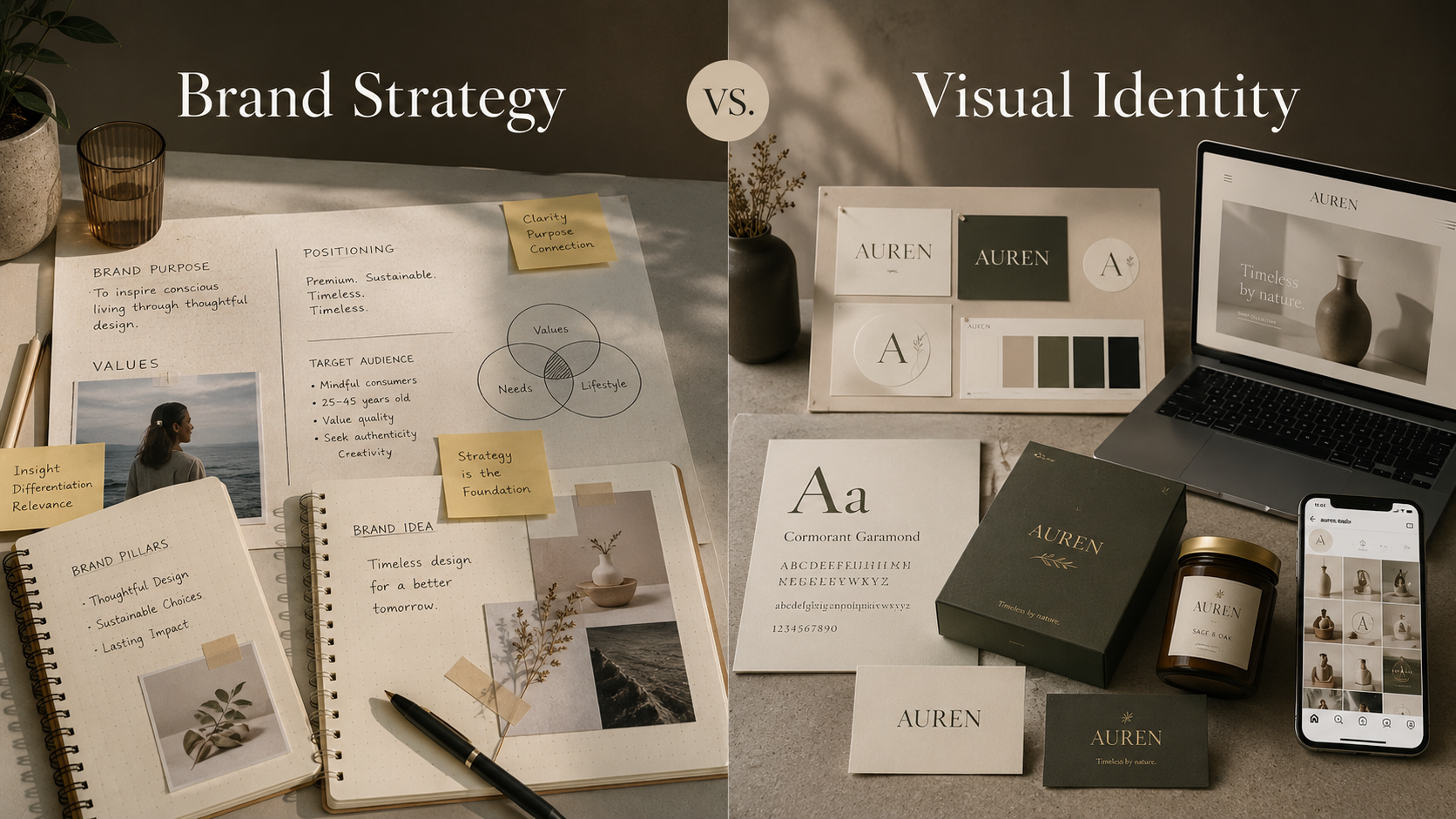
Brand strategy and visual identity are often discussed as if they mean the same thing, but they serve two very different purposes.
Brand strategy defines the direction behind your brand. Visual identity determines how that direction looks.
One helps answer questions like who you serve, what makes your business different, and how you want customers to perceive you. The other turns those ideas into recognizable visual elements such as your logo, colors, typography, imagery, and overall design style.
Understanding the difference can help you invest in the right kind of branding work—and avoid redesigning the surface of your business when the real problem may be deeper.
Quick answer
Brand strategy = what your brand stands for and how it is positioned.
Visual identity = how your brand looks and is visually recognized.
Most strong brands eventually need both, but not every business needs to develop both at the same time.
What Is Brand Strategy?
Brand strategy is the foundation behind how your business is positioned, understood, and remembered.
It helps define the ideas that should guide your messaging, design, customer experience, and marketing decisions so your brand feels intentional rather than pieced together over time.
A brand strategy can include:
- Target audience
- Brand positioning
- Value proposition
- Messaging
- Brand personality
- Competitive differentiation
- Customer perception
- Creative direction
- Long-term brand goals
A strong strategy helps answer questions like:
Who are we trying to reach?
What should customers understand about us?
Why should they choose us instead of a competitor?
What should the brand feel like?
How should we communicate consistently as the business grows?
Without that foundation, businesses can end up changing their messaging, design, or marketing direction every few months because there is no clear system guiding those decisions.
What Is Visual Identity?
Visual identity is the part of your brand that people can see.
It takes the ideas defined through brand strategy and translates them into a consistent visual system that helps customers recognize your business across different platforms and materials.
A visual identity can include:
- Logo and logo variations
- Brand colors
- Typography
- Photography and imagery style
- Graphic elements
- Patterns and textures
- Icons and illustrations
- Layout and spacing systems
- Packaging and print applications
- Digital brand applications
- Visual identity guidelines
A strong visual identity helps answer questions like:
What should our brand look like?
Which colors and fonts should we use?
How should our logo appear in different situations?
What type of imagery fits the brand?
How do we keep everything looking consistent across web, social media, packaging, and print?
Without a defined visual system, businesses often end up with a logo they like but no clear direction for how the rest of the brand should look. That can lead to inconsistent marketing materials, mismatched social graphics, and a website that feels disconnected from the rest of the business.
Brand Strategy vs. Visual Identity: Side-by-Side
The easiest way to understand the difference is to look at what each one is responsible for.
Brand Strategy
- Defines who the brand is
- Identified the target audience
- Clarifies positioning
- Shapes messaging and value proposition
- Defines brand personality
- Identifies competitive differentiation
- Guides long-term brand decisions
- Influences marketing and customer experience
Visual Identity
- Defines how the brand looks
- Establishes colors, typography and imagery
- Creates logo systems and visual elements
- Creates consistency across design applications
- Translates personality into a visual style
- Helps the brand look distinctive in the market
- Guides how future creative materials should look
- Influences websites, packaging, social media, print and signage
A useful way to think about it is:
Brand strategy answers “What should people think and feel about this business?”
Visual identity answers “What should they see that reinforces that perception?”
For example, a brand strategy might determine that a company should feel premium, approachable, modern and trustworthy. The visual identity would then use typography, color, photography, layout and design elements to communicate those qualities consistently.
One can exist without the other, but the strongest brands usually connect both.
Which One Does Your Business Need?
The right starting point depends on what is actually causing the disconnect in your brand.
You may need Brand Strategy if:
- You are not sure how to position your business
- Your messaging changes depending on where it appears
- Customers do not clearly understand what makes you different
- You are launching a new business or entering a new market
- Your services or audience have changed significantly
- You keep redesigning things because the overall direction is unclear
- Your brand looks fine visually, but the business still feels difficult to explain
In these cases, the problem is usually deeper than design. You may need to clarify the brand before changing how it looks.
You may need Visual Identity if:
- Your positioning and messaging are already clear
- Your logo, colors, fonts, and imagery feel inconsistent
- Your website does not match your social media, packaging, or print materials
- Different designers or vendors interpret the brand differently
- Your existing identity feels dated
- You have a logo but no complete visual system
- You want the brand to look more polished and recognizable without changing what it stands for
In these cases, the strategy may already be strong enough, but the visual execution needs more structure.
You may need both if:
Your business has evolved enough that both the direction and the visual presentation no longer reflect where the company is today.
That is common during a rebrand, business expansion, repositioning, or major shift in audience.
A simple way to decide:
If the problem is what your brand means → start with Brand Strategy.
If the problem is how your brand looks → start with Visual Identity.
If both feel unclear → you likely need both.
Can You Have a Visual Identity Without a Brand Strategy?
Yes—but it usually works better when there is at least some strategic thinking behind the design.
A business can create a logo, choose colors, select fonts, and develop marketing materials without going through a formal brand strategy process. For a small or straightforward business, that may be enough to get started.
The challenge is that visual decisions become much harder to evaluate when there is no clear direction behind them.
Without strategy, design choices can become based mostly on personal preference:
- “I like this color.”
- “That logo feels modern.”
- “This competitor uses this style.”
- “Let’s try a different font.”
Those decisions are not necessarily wrong, but they may not answer the more important question: Does this visual direction support how the business needs to be perceived?
A well-defined strategy gives visual identity something to respond to. If the brand is meant to feel sophisticated, approachable, disruptive, technical, playful, luxurious, or dependable, the design system can be built intentionally around those characteristics.
That does not mean every business needs an extensive strategy engagement before any design work begins. The amount of strategy should match the complexity of the business and the problem being solved.
The important thing is that the visual identity is not being designed in a vacuum.
Can You Change Your Visual Identity Without Rebranding the Entire Business?
Yes. Updating your visual identity does not always mean changing the entire brand.
If your positioning, audience, messaging, and overall business direction are still working, you may only need a visual refresh rather than a complete rebrand.
That could include updating:
- Your color palette
- Typography
- Photography style
- Graphic elements
- Layout system
- Logo variations
- Social media templates
- Packaging
- Website presentation
- Brand guidelines
The goal is to improve how the brand looks and feels without changing what the business fundamentally stands for.
A visual refresh can be especially useful when a company has grown but its design still reflects an earlier stage of the business.
For example, you may have a recognizable logo that customers already know, but the rest of the brand feels inconsistent or outdated. In that case, keeping the logo while modernizing the supporting visual system can preserve brand recognition while creating a more polished and current appearance.
A full rebrand is more appropriate when the business itself has changed significantly—such as a new audience, new positioning, major service shift, merger, or change in how the company wants to be perceived.
Visual refresh = improve the presentation.
Rebrand = reconsider the direction and the presentation together.
How Brand Strategy and Visual Identity Work Together
rand strategy and visual identity are strongest when they support the same idea.
The strategy defines the direction of the brand—who it is for, what it should communicate, how it should be positioned, and what customers should remember about it.
The visual identity then turns that direction into something people can actually see and recognize.
For example, if the strategy says a brand should feel:
- Premium
- Modern
- Approachable
- Dependable
- Innovative
The visual identity can reinforce those qualities through:
- Typography
- Color
- Photography
- Logo treatment
- Layout
- Packaging
- Graphic elements
- Website design
When the two are aligned, the brand feels intentional. The messaging and the visuals reinforce each other instead of competing for attention.
That consistency becomes especially important as the business grows across more touchpoints—website, social media, print, packaging, advertising, signage, presentations, and customer communications.
A strong brand does not just look consistent. It communicates consistently.
Common Branding Mistakes Businesses Make
Branding problems are not always caused by a bad logo. Often, the bigger issue is inconsistency or a lack of clear direction.
Designing Before Defining the Brand
Choosing colors, fonts, and a logo before clarifying the audience, positioning, and personality can lead to a visual identity that looks attractive but does not communicate the right message.
Changing the Look Too Often
Constantly switching colors, fonts, graphics, or styles makes it harder for customers to recognize and remember the brand.
Treating the Logo as the Entire Brand
A logo is important, but it is only one part of the visual identity. Typography, imagery, layout, messaging, packaging, and customer experience all contribute to how a brand is perceived.
Copying Competitors Too Closely
Competitor research can be useful, but following the same visual trends too closely can make a business blend into the market instead of standing apart.
Ignoring Consistency Across Touchpoints
A polished website paired with inconsistent social graphics, packaging, signage, or printed materials can make the overall brand feel fragmented.
Designing Only Around Personal Preference
The owner should feel connected to the brand, but design decisions should also consider the audience, market, positioning, and business goals.
Skipping Brand Guidelines
Without clear standards, the brand can gradually become inconsistent as more people, vendors, or platforms create new materials.
The strongest branding decisions are usually the ones that balance strategy, creativity, consistency, and real-world usability.
Brand Strategy or Visual Identity: Where Should You Start?
Brand strategy and visual identity are closely connected, but they are not interchangeable.
Brand strategy defines the direction. Visual identity gives that direction a recognizable form.
If your business is struggling with positioning, messaging, audience, or differentiation, start with strategy. If the business direction is already clear but the visual presentation feels inconsistent, outdated, or incomplete, visual identity may be the better place to begin.
For some businesses, both need attention at the same time.
The right approach depends on what has changed in your business, what is no longer working, and how you want customers to experience the brand moving forward.
Need Help Deciding?
LUCKI MEDIA can help evaluate whether your business needs a stronger strategic foundation, a more cohesive visual identity, or a combination of both.

Related Posts



Build a brand that speaks louder than words
When you are alone for days or weeks at a time, you eventually become drawn to…